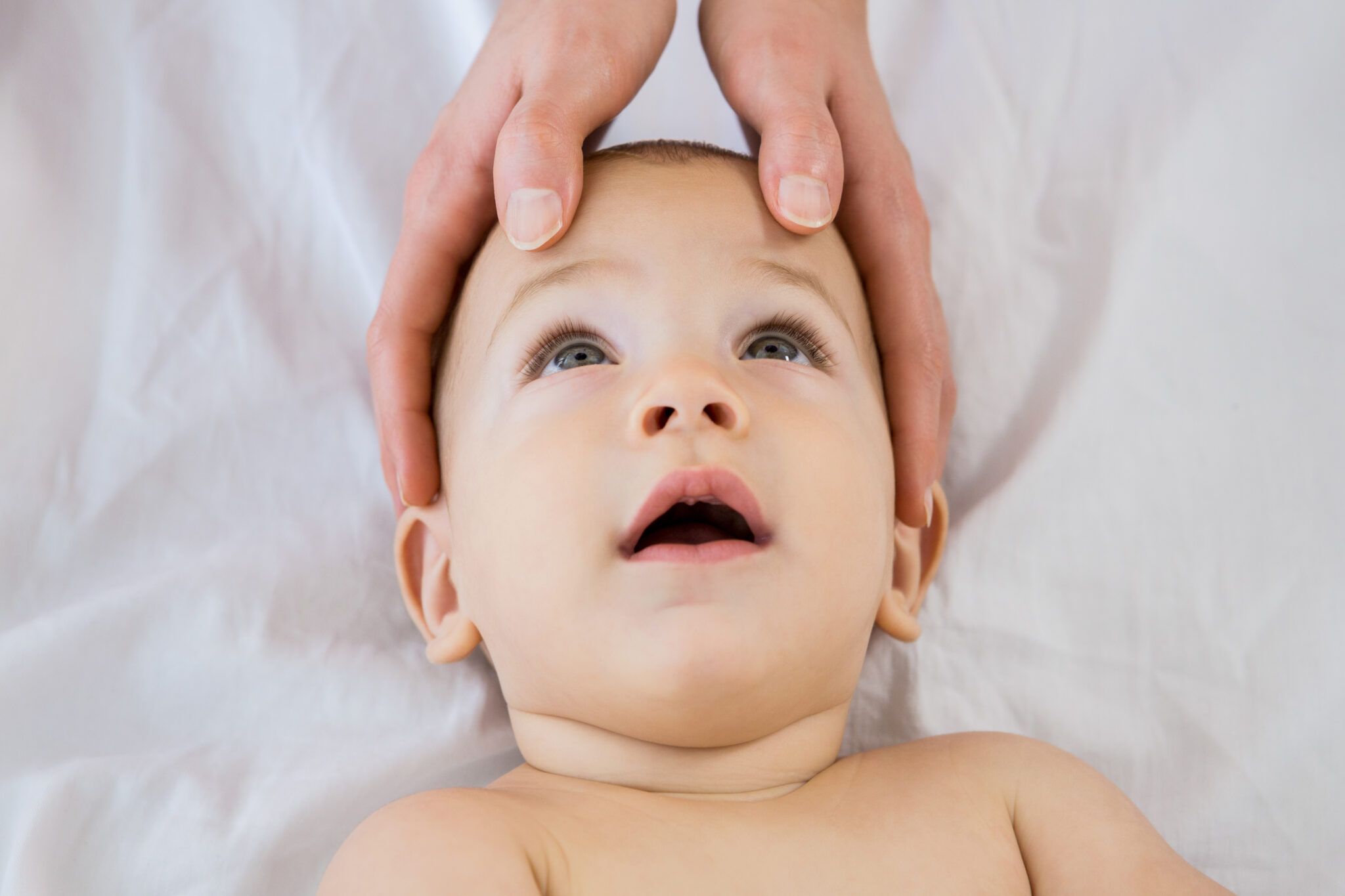
Understanding and treating cranial deformities in babies through osteopathy
Plagiocephaly, brachycephaly, dolichocephaly, and scaphocephaly... How can we demystify these cranial deformations?Plagiocephaly, brachycephaly, dolichocephaly, and scaphocephaly are cranial deformationsfound in infants, occurring in 22% to 45% of babies between 4 to 8 weeks3. This article will help you understand and learn moreabout these cranial asymmetries, but also to understand how osteopathy can helpin these situations.
WHAT IS PLAGIOCEPHALY?
Plagiocephaly is a cranial deformity characterized by unilateral flattening (on the right or left side) of the head in infants. The shape of the head may then resemble a parallelogram (see image below – head on the left and in the center). Plagiocephaly is usually detected by a doctor, healthcare professional, or parents around 2–3 months of age. In addition, it is not uncommon to see plagiocephaly accompanied by torticollis. Torticollis usually manifests as rotation of the head to one side and tilting of the opposite side.
WHAT IS BRACHYCEPHALY?
Brachycephaly is a symmetrical flattening of the back of the head (as shown in the image below, on the head on the right). Babies with brachycephaly may have a wider head and a rounder face. In some cases, the back of the head may be slightly more conical in shape. Infants with brachycephaly often show no preference for rotation or tilting; they are comfortable with their head in the center.
Types of plagiocephaly and brachycephaly1
WHAT ARE DOLICHOCEPHALY AND SCAPHOCEPHALY?
Dolichocephaly, also known as scaphocephaly, is characterized by a narrower and longer head (see image below). This deformity usually develops in utero, due to the baby's position, often in a breech position. This deformity can also be seen in premature babies. Babies with this skull deformity are often more comfortable lying on their sides.
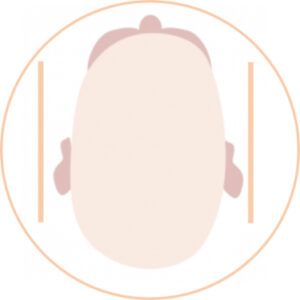
Image of dolichocephaly2
WHAT ARE THE CAUSES OF PLAGIOCEPHALY AND BRACHYCEPHALY? 4.6
During pregnancy and childbirth
- Lack of space in the uterus (twin, first baby, etc.)
- Small uterus
- Poor fetal positioning
- Baby's head prematurely engaged in the pelvis
- Prolonged labor during childbirth (which causes the head to be compressed in the pelvis)
- Premature baby
After childbirth
- Assisted birth (use of vacuum/forceps)
- Positioning during feedings (if always on the same side)
- Prolonged period lying on the back or with the head supported (car seat, recliner, etc.)
- Stiff neck or lack of neck mobility
- Little time on the stomach or lack of stimulation
WHAT ARE THE CONSEQUENCES OF CRANIAL DEFORMATIONS ?
Cranial deformities do not generally have serious consequences; they are often cosmetic. However, they could certainly interfere with the child's motor development. For example, in cases of plagiocephaly, where one side of the head is flat, the baby may develop asymmetrical posture and skills. This could lead to a lack of coordination on both sides. This could make it difficult for them to turn their head to one side, crawl using both hands and legs, etc. It is therefore best to treat the infant as soon as a skull deformity is noticed. In more severe cases of cranial deformation, the doctor may prescribe a helmet, which is a plastic orthosis with foam inside, to help the head maintain and regain its roundness.
WHAT CAN AN OSTEOPATH DO IN CASE OF CRANIAL DEFORMITIES?
During a session with the osteopath, they will take the time to talk with you to learn more about the pregnancy, childbirth, and the baby's habits. Then, they will perform a comprehensive evaluation to assess the mobility of different body parts. In cases of cranial deformities, the osteopath will pay special attention to the pelvis, shoulders, neck, and head. Cranial work is even more effective before 12 months as the skull is still malleable.
Regarding the frequency and number of appointments, this will depend on the severity of the cranial deformity as well as its progression. The osteopath can also give you some advice and possibly invite you to consult in
pediatric physiotherapy to work together. Physiotherapy will be a good complement in terms of exercises to help the baby regain mobility and to promote optimal cranial growth. 4
To learn more about other reasons for consulting in osteopathy for infants, click here.
WHAT CAN PHYSIOTHERAPY DO FOR CRANIAL DEFORMITIES?
During a session with the physical therapist, she will take the time to discuss with you about the baby's habits, birth, motor development, and health conditions, if applicable. Then, she will conduct a thorough evaluation of the baby to assess their posture, measure the shape of the skull, measure the range of neck movements, strength, and motor skills to determine the cause of the cranial deformation. Depending on the issues found during the evaluation, exercises for positioning, stretching, mobility, or strengthening will be suggested to promote symmetrical strength and movements to encourage the baby's proper development.
Depending on the severity of the cranial deformation, a referral to a pediatrician may be offered to assess the possibility of using a helmet to properly shape the skull.
Regarding the frequency and number of appointments, this will depend on the severity of the cranial deformation, its cause, and how it progresses. The physiotherapist may also give you some advice and possibly invite you to consult in pediatric osteopathy to work on the cranial box.
SOME ADVICE TO AVOID THE RISK OF POSTNATAL CRANIAL DEFORMITIES POST-NATAL
- Switching sides during feeds
- Change of position with the changing of layers
- Move the baby seat so that the baby turns its head towards us
- Develop the prone position (at least 1 hour per day, divided into several short periods)
- Make sure that the baby looks as often to the right as to the left
- Using the baby carrier
- Pediatric physiotherapy and pediatric osteopathy consultation
DID YOU KNOW THAT …
Since the late 1990s, there has been an increase in the number of babies with plagiocephaly. This could possibly be due to the campaign for education, "Back to Sleep", launched by Health Canada and the Canadian Paediatric Society to combat sudden infant death syndrome in 1999. In this regard, the recommendation aims to have babies sleep on their backs, which has had a major impact as the rate of sudden infant death has decreased by 60% between the years 1999 and 2004.5
OTHER ARTICLES THAT MIGHT INTEREST YOU
Obstetric Osteopathy: How can an osteopath help me during my pregnancy?
How can physiotherapy help me with urinary incontinence while running?
BIBLIOGRAPHIC REFERENCES
1. Femina. (September 21, 2020). Plagiocephaly – Cranial Deformation. https://www.cliniquefemina.com/publication/plagiocephalie-deformation-cranienne-positionnelle
2. Grausoler Orthopedics. (n.d). Most common cranial pathologies in babies. https://plagiocefalia.barcelona/fr/pathologies-craniennes/
3. Lam, S., Pan I-W., Strickland, B A., Hadley, C., Daniels, B., Brookshier, J., Luerssen, T G. (2017). Factors influencing outcomes of the treatment of positional plagiocephaly in infants: a 7-year experience. Journal of neurosurgery : Pediatrics. 19(3),273-281. https://doi.org/10.3171/2016.9.PEDS16275
4. Professional Order of Physiotherapy of Quebec. (n.d). Plagiocephaly: why does my baby have a flat head? https://oppq.qc.ca/blogue/plagiocephalie/
5. Canadian Paediatric Society. (May 10, 2022). Preventive Positioning: Sudden Infant Death Syndrome Yesterday and Today. https://cps.ca/fr/blog-blogue/le-positionnement-preventif-la-mort-subite-du-nourrisson-hier-et-aujourdhui
6. Vlimmeren, L A., Van der Graaf, Y., Boere-Boonekamp, M M., L’Hoir, M P., Helders, P J M., Engelbert R H H. (2012). Risk factors for deformational plagiocephaly at birth and at 7 weeks of age: a prospective cohort study. Pediatrics.119(2), 408-18. https//doi.org/10.1542/peds.2006-2012
Back pain: how physiotherapy relieves lo...
Persistent lower back pain? Discover how physiotherapy can effectively relieve your backache with a ...
Lire plus...
Persistent Pain: Why Do Your Symptoms Fl...
Does your pain feel unpredictable? Discover the scientific mechanisms behind daily fluctuations and ...
Lire plus...
Beyond Recovery: Understanding Functiona...
our pain has decreased, but are you truly ready to return to your daily routine? Learn how Functiona...
Lire plus...