Lifting your morning coffee, sending a text, or simply opening a jar—these are mundane tasks until a sharp pain at the base of your thumb makes them a challenge. If this sensation feels familiar, you may be experiencing what is known as De Quervain’s Tenosynovitis.
At Physio-Ostéo Globalité, we believe that understanding the source of your discomfort is the first step toward well-being. Let’s explore this common, yet often misunderstood, condition together.
What is De Quervain’s Tenosynovitis?
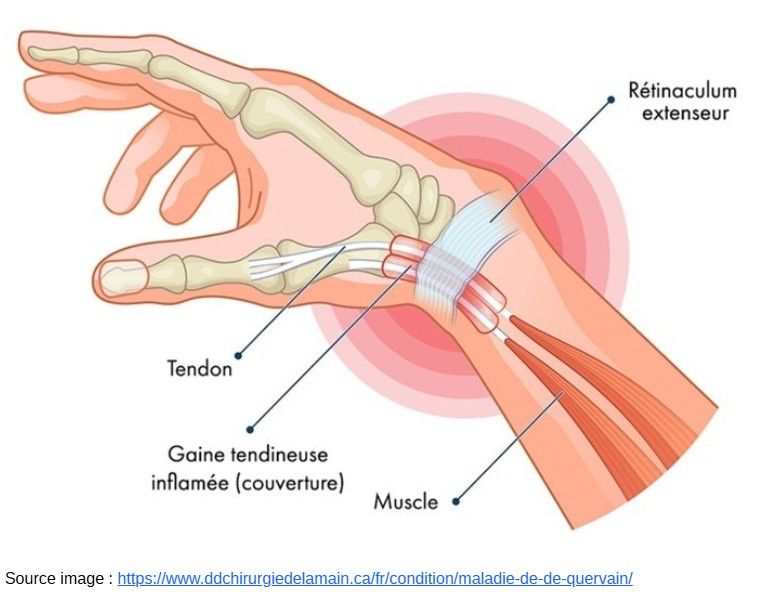
To understand what is happening in your wrist, imagine a piece of precision machinery. The movements of your thumb are powered by two main tendons: the extensor pollicis brevis (EPB) and the abductor pollicis longus (APL).
These two tendons slide through a small tunnel (a tendon sheath) located on the thumb-side of the wrist. Normally, they glide freely, allowing you to extend and move your thumb away from your hand.
In the case of De Quervain’s, the space inside this tunnel becomes restricted. The tendons or the sheath itself become irritated and inflamed, creating friction. As a result, movements that should be fluid become "catchy" and painful.
Common Signs and Symptoms
Every person’s experience is unique, and only a clinical evaluation can confirm the nature of your discomfort. However, common signs often reported by those affected include:
- Localized pain: Pain felt at the base of the thumb that may travel up the forearm. It can sometimes be sharp enough to wake you up at night.
- A "sticking" sensation: A feeling of resistance or "snapping" when moving the thumb.
- Loss of strength: Difficulty gripping objects or performing "pinch" movements.
- Inflammation: Swelling, a sensation of heat, or tenderness on the side of the wrist near the base of the thumb.
Why Me? Common Causes
This condition rarely appears without a reason. It is often linked to unusual or repetitive strain on the wrist and thumb:
- Repetitive Motions: Office work (keyboard/mouse use), gardening, or heavy smartphone use put significant stress on these tendons.
- "Mommy Wrist": Hormonal changes during pregnancy combined with the repetitive lifting of a newborn make new mothers particularly vulnerable.
- Heavy Gripping: Squeezing tools or objects too tightly for extended periods.
- Trauma: A direct blow to the wrist can trigger the initial inflammation.
The Occupational Therapy Approach: Reclaiming Your Movement
If you are experiencing these symptoms, an Occupational Therapist (OT) is a valuable ally in helping you return to your activities with pleasure and confidence. Here is how our team typically supports you:
1. Global Assessment
It all starts with a conversation and gentle testing to understand how the pain limits your daily life—whether at work, during hobbies, or for personal care.
2. Calming the Inflammation (Acute Phase)
The first goal is to reduce irritation. Your OT will teach you joint protection techniques and strategies to modify your daily gestures, allowing the tendons to "rest" and heal.
3. Custom Support
In some cases, the recommendation or fabrication of a custom thumb splint (orthotic) is prioritized. This helps hold the joint in an optimal position to promote recovery.
4. Gradual Return to Action
Once the inflammation has subsided, we move toward manual therapy and graduated exercises. We focus on regaining mobility and strength so you can return to your routine safely.
A Note for the Road
It is important not to ignore persistent pain. Generally, the earlier the intervention, the smoother the recovery process. A healthcare professional will be able to evaluate your specific situation and determine the best plan of action for you.
At our clinic, we focus on mutual aid between our various professionals—physiotherapists, osteopaths, and occupational therapists—to offer you a holistic view of your health.
Would you like to rediscover comfort in your movements? Our occupational therapists are here to listen and support you with care and expertise.
Book your occupational therapy consultation now!

Back pain: how physiotherapy relieves lo...
Persistent lower back pain? Discover how physiotherapy can effectively relieve your backache with a ...
Lire plus...
Persistent Pain: Why Do Your Symptoms Fl...
Does your pain feel unpredictable? Discover the scientific mechanisms behind daily fluctuations and ...
Lire plus...
Beyond Recovery: Understanding Functiona...
our pain has decreased, but are you truly ready to return to your daily routine? Learn how Functiona...
Lire plus...