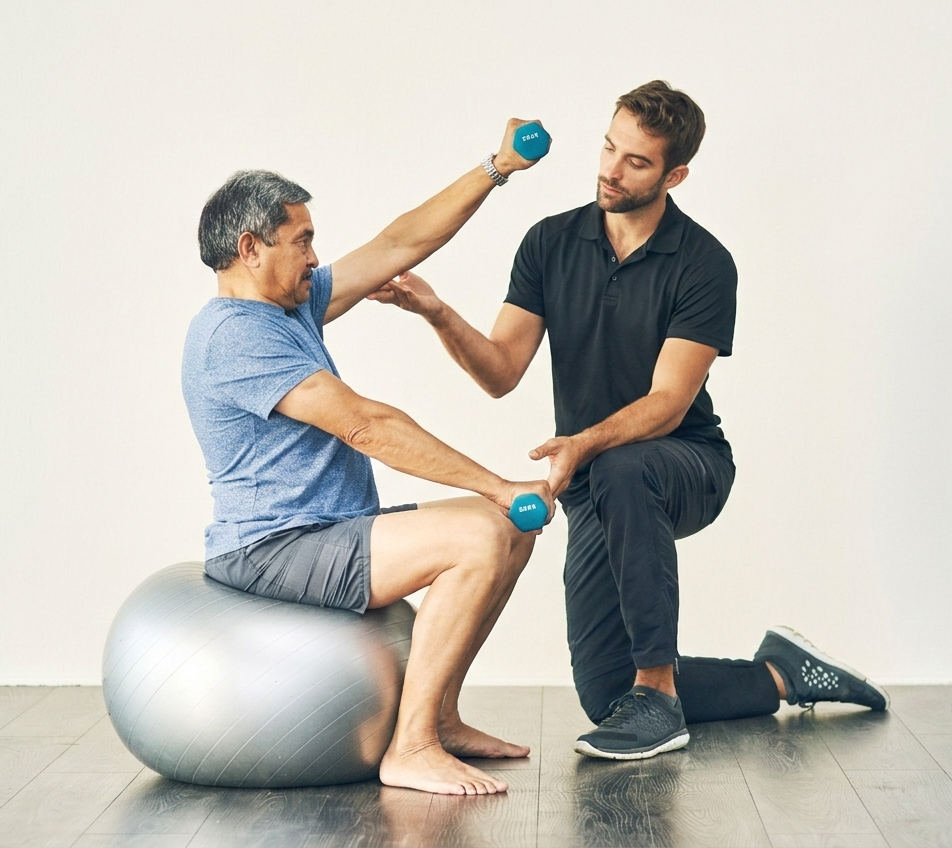
You’re feeling better… but are you ready for action?
You’ve completed your physiotherapy or occupational therapy treatments. Great news: your pain has subsided, and your condition has stabilized. Now, your care team mentions starting an FCD program (often referred to as DCF in Quebec). For many, this term can feel a bit unclear. Why continue if the pain is gone? At Physio-Ostéo Globalité, we see FCD as the essential bridge between healing an injury and returning to an active life with pleasure.
What exactly is FCD?
FCD stands for Functional Capacity Development. While the initial phase of your care focused on calming inflammation and reducing pain, FCD is the rebuilding stage. This is when we help your body regain the ability to meet the demands of your daily life—whether for work, sports, or family activities.
It’s vital to remember that feeling better doesn't always mean being ready. Reducing pain is a victory, but regaining the strength and stamina needed for a full day of work is another challenge entirely.
Why is this stage necessary?
After an injury, the body often changes its habits. To avoid pain, we compensate: we lift differently or become more sedentary. FCD corrects these adaptations before they become permanent. It is a completely normal phase if you still experience quick fatigue, a loss of strength, or some hesitation when performing certain movements.
What we focus on in the clinic
An FCD program is custom-tailored training for your real life, built on four pillars:
- Progressive Tolerance: We expose your body to increasing effort (duration, weight, repetitions) in a very controlled manner.
- Movement Quality: We teach you how to move more efficiently to reduce unnecessary compensations.
- Functional Endurance: We simulate real-world movement sequences (lifting, pushing, pulling) so your body can tolerate repetitive tasks over time.
- Body Confidence: By working in a safe, supervised environment, you regain trust in your physical abilities.
A Team Effort (Mutual Aid)
FCD takes place in an interdisciplinary setting. Several professionals work together to support your progress:
- The Kinesiologist supervises your daily exercises and adjusts the difficulty level.
- The Occupational Therapist tailors task simulations to match the specific requirements of your job.
- The Physiotherapist monitors any residual symptoms.
This synergy ensures your progress is consolidated, leading to stable and long-lasting functional capacity.
“Important Note: Every situation is unique. A healthcare professional will be able to evaluate your specific situation to determine if an FCD program is the right step for your recovery.”

Back pain: how physiotherapy relieves lo...
Persistent lower back pain? Discover how physiotherapy can effectively relieve your backache with a ...
Lire plus...
Persistent Pain: Why Do Your Symptoms Fl...
Does your pain feel unpredictable? Discover the scientific mechanisms behind daily fluctuations and ...
Lire plus...Beyond Recovery: Understanding Functiona...
our pain has decreased, but are you truly ready to return to your daily routine? Learn how Functiona...
Lire plus...