
Postpartum running: where to start to avoid injuries?
DO YOU WISH TO RESUME RUNNING AFTER GIVING BIRTH?
A physiotherapy consultation with our https://poglobalite.com/physiotherapie-perineale/, trained by the Runner's Clinic, can help you do just that! A comprehensive assessment will allow us to give you the appropriate exercises and a safe running recovery program tailored to your condition!!
HOW TO DETERMINE IF I AM READY TO START RUNNING AGAIN?
Before resuming running, it is important to ask yourself several questions to determine your body's capacity to adapt to this type of effort.
- Was it a vaginal birth or a cesarean?
- Do I have a prolapsed organ?
- What is the strength of my pelvic floor?
- Did I run during pregnancy?
- What is the strength of my abs?
- Am I breastfeeding?
- Etc.
It is important to consider these aspects as much as the number of postpartum weeks and the symptoms experienced.
Indeed, a woman who has run during pregnancy up to 34 weeks may possibly be able to start running again sooner or for longer periods than someone who stopped running at the beginning of the pregnancy or who has never run.
HOW CAN A PELVIC FLOOR REHABILITATION PHYSIOTHERAPIST HELP ME?
Pour un retour sécuritaire à la course à pied, une évaluation préalable de la fonction du plancher pelvien et des abdominaux est fortement recommandée. En effet, le plancher pelvien, constitué de muscles, de ligaments, de fascias, de vaisseaux sanguins et de nerfs, est énormément sollicité durant la course à pied. Il en va de même pour tous les sports d’impacts. Sachant que la grossesse et l’accouchement affectent la fonction du plancher pelvien, il est important de l’évaluer avant de reprendre l’activité physique.
During the perineal physiotherapy assessment, several aspects will be observed such as posture, the movements of the back and hips as well as diastasis and the competence of the abdominals. Subsequently, following explanations on the relevance of this practice and with your consent, an intravaginal evaluation will be performed to assess several aspects of the pelvic floor:
- Scar adhesion (if present)
- Pelvic organ prolapse
- Tone
- Force
- Speed
- Coordination
- Synchronisation
- Ability to release
- Etc.
MAKE AN APPOINTMENT BY CLICKING HERE
WHAT IS A DIASTASIS?
Diastasis recti is a separation of more than 2 cm (at 3 cm above the navel) of the superficial part of the abdominal muscles known as the rectus abdominis. A non-functional diastasis is characterized by a decrease in the contractility of the transverse abdominal muscle, the deepest of the abdominal muscles.
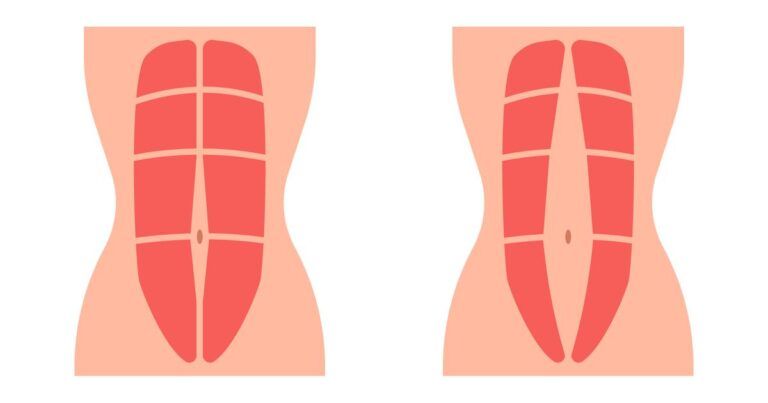
Diastasis recti.
Une fois l’évaluation réalisée, un ou plusieurs exercices pourront vous être proposés afin d’optimiser un ou plusieurs des aspects évalués. On pourrait, par exemple, vous donner des exercices de renforcement du plancher pelvien et des abdominaux (dont le transverse) préalablement au début d’un programme de cours à pied ou d’entraînement. Il est important de se rappeler que chaque accouchement est différent et donc chaque programme de reprise de l’activité physique doit être individualisé et adapté à l’individu.
HOW CAN I START RUNNING AGAIN SAFELY?
De manière générale, on recommande d’attendre environ 6 à 8 semaines après l’accouchement avant de reprendre la course à pied de façon progressive en raison du temps de guérison naturel des tissus. Cela signifie que la première sortie de course ne durera pas 20 minutes en continu. Par conséquent, il faudra donc débuter par un programme par intervalles durant lequel on alterne entre la marche et la course. Il est également important de commencer avec un échauffement et de terminer par un retour au calme tel que la marche. Finalement, il faudra aussi surveiller les symptômes décrits dans la section suivante pour vous assurer que l’intensité ou la durée de la course n’excède pas la capacité de votre corps à s’adapter. Sachez que le manque de sommeil peut être un facteur de risque, car il peut nuire à la capacité de votre corps à s’adapter aux impacts de la course à pied.
WHEN SHOULD I STOP RUNNING?
When you resume running, it is crucial to pay attention to the signals that your body may send you. These signals can be in the form of pain, heaviness, pressure or urinary incontinence, for example. Here are the symptoms of the abdominal, lumbar, and pelvic regions to watch out for when you start running again:
- Urinary or fecal incontinence
- Heaviness/pressure in the vagina or rectum
- Heaviness or pain in the lower abdomen
- Increase or return of lochia (postpartum vaginal bleeding)
- Frequent urges to urinate
- Lower back pain
- Hip pain
- Perineal pain
If ever you experience any of these symptoms, it's a sign that you're probably doing too much and you should consult your pelvic floor and perineal rehabilitation physiotherapist. An evaluation, exercises, and appropriate advice for your condition can then help you resume physical activity.
Consequently, after childbirth, it is recommended to seek pelvic floor physiotherapy starting from the 6th week postpartum to ensure a safe return to running and optimal health of the back, abdominal muscles, and pelvis.
HERE ARE SOME OTHER ARTICLES THAT MIGHT INTEREST YOU
How can physiotherapy help me with urinary incontinence when running?
Back pain, have you considered seeing an osteopath?
Obstetric Osteopathy: How can an osteopath help me during my pregnancy?
BIBLIOGRAPHIC REFERENCES
Christopher, Shefali Mathur PT, DPT, PhD1,2; Gallagher, Sandra PT, DPT3; Olson, Amanda PT, DPT4; Cichowski, Sara MD, FACOG5; Deering, Rita E. PT, DPT, PhD6. Rehabilitation of the Postpartum Runner: A 4-Phase Approach. Journal of Women’s Health Physical Therapy 46(2):p 73-86, April/June 2022. | DOI: 10.1097/JWH.0000000000000230
Kaufmann, R.L., Reiner, C.S., Dietz, U.A. et al. Normal width of the linea alba, prevalence, and risk factors for diastasis recti abdominis in adults, a cross-sectional study. Hernia 26, 609–618 (2022). https://doi.org/10.1007/s10029-021-02493-7 (https://doi.org/10.1007/s10029-021-02493-7)
Meier, K. (January 27, 2022). Diastasis recti – a problematic curvature of the abdomen. https://focus.swiss/lifestyle/sante/la-diastase-des-muscles-grands-droits-une-courbure-problematique-de-labdomen/
Paquette, P., Fortin, R. and Gagné, R. (n.d). Pregnancy: how to prevent and treat diastasis recti? Professional Order of Physiotherapy of Quebec. https://oppq.qc.ca/blogue/prevenir-et-traiter-la-diastase-des-grands-droits/
Back pain: how physiotherapy relieves lo...
Persistent lower back pain? Discover how physiotherapy can effectively relieve your backache with a ...
Lire plus...
Persistent Pain: Why Do Your Symptoms Fl...
Does your pain feel unpredictable? Discover the scientific mechanisms behind daily fluctuations and ...
Lire plus...
Beyond Recovery: Understanding Functiona...
our pain has decreased, but are you truly ready to return to your daily routine? Learn how Functiona...
Lire plus...