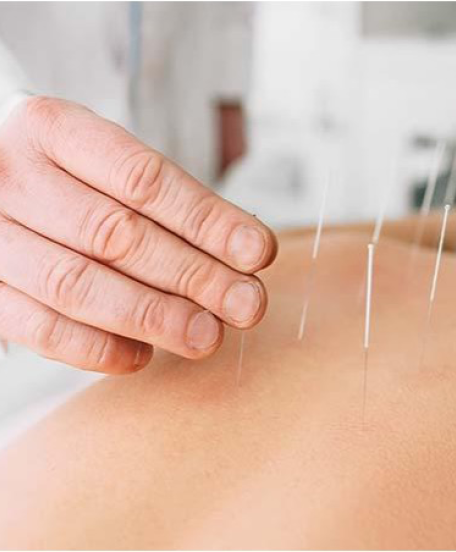
Acupuncture: an energy technique from traditional Chinese medicine
Acupuncture is a branch of traditional Chinese medicine (TCM) that has been practiced for several millennia. Traditional Chinese medicine is based on the observation of living organisms, and the individual is considered as a whole, body and spirit, with their strengths and weaknesses, within their living environment.
It is an energy treatment that involves stimulating certain sites of the skin, mucous membranes, or subcutaneous tissues using fine needles with the aim of relieving pain or improving the patient's health and quality of life.
The acupuncturist regulates the energy flow by stimulating certain acupuncture points. If the Qi (energy) is abundant and flows harmoniously, the body receives the nutrients and vitality it needs to perform its various functions (digestion, elimination, respiration, oxygenation, tissue repair...).
Acupuncture treatment is performed using needles, but the acupuncturist may also use various other instruments and techniques: cupping, guasha, moxa, electromagnetic lamp, electrostimulation, laser, bleeding, tuina massage, acupressure… The acupuncturist may also provide lifestyle advice to reinforce the results of the treatment and prevent relapses.
The benefits of acupuncture
Acupuncture has several benefits such as:
- pain relief (analgesic)
- a sedative and relaxing effect
- restores homeostasis (the body's natural balance)
- boosts the immune system's efficiency
- promotes the flow of energy.
Acupuncture treatments can be preventive, therapeutic, or complementary.
The disorders treated by acupuncture
Acupuncture can treat a wide variety of conditions, both chronic and acute, including:
- Allergies
- Asthma and respiratory disorders (sinusitis, bronchitis, rhinitis...)
- Headaches and migraines
- Various pains (acute and chronic)
– Capsulitis, tendinitis, bursitis, sprain, epicondylitis, stiff neck, periostitis….
– Rheumatism, neuralgia, muscle pains, fibromyalgia….
– Heel spur, plantar fasciitis, carpal tunnel, Morton's neuroma…. - Fatigue, chronic fatigue syndrome
- Insomnia
- Anxiety and stress
- Menopause (hot flashes, insomnia...)
- Gynecological issues
- Digestive issues (nausea, irritable bowel, acid reflux, constipation...)
- Urinary troubles (incontinence, cystitis...)
- Circulatory issues (edema, numbness, restless legs...)
- Skin problems (eczema, psoriasis, shingles...)
- Eye problems (dry eyes...)
- Hearing problems (otitis, vertigo...)
- Oncology (chemo and radio side effects)
- Quit smoking
- Etc…..
What happens during an acupuncture treatment?
The basic technique involves inserting very fine needles into specific points on the body with the aim of triggering precise physiological mechanisms:
Physiological actions
The insertion of a needle into tissue triggers biochemical reactions such as vasodilation and the stimulation of neuromediators. The information carried by the afferent nerve fibers is transmitted to the central nervous system and acts on sensory mechanisms such as pain and motor mechanisms (movement and strength). Acupuncture also affects the autonomic nervous system, both parasympathetic and sympathetic, which helps to modulate various functions and organic reactions (digestion, elimination, respiration, homeostasis, sleep, etc.).
Actions according to classical TCM
By stimulating acupuncture points, the flow of Qi (energy) is promoted. Qi is a concept that encompasses notions of movement, protection, temperature, function, and transformation. When Qi flows well, blood circulates well, nutrients and immune agents circulate well, hormones and neurotransmitters reach their destinations, organ functions are optimal, and exchanges and transformations (e.g., digestion, respiration, oxygenation, tissue repair) occur as they should.
Are the treatments painful?
The insertion of acupuncture needles gives a sensation similar to a mosquito bite. Once the needles are in place, the patient generally feels a sense of well-being and relaxation.
How many treatments are required?
The number of acupuncture sessions varies depending on the patient's health condition and age, the intensity of the symptoms, and the duration of the issue.
Reasons for consulting with pregnant women
- Nausea
- Gastroesophageal reflux disease (GERD)
- Insomnia
- Anxiety
- Edema
- Varicose veins
- Hemorrhoids
- Vaginitis
- Threat of premature labor
- High blood pressure induced by pregnancy
- Constipation
- Intrauterine growth retardation
- Oligohydramnios
- Polyhydramnios
- Itching
- Gestational diabetes
- Childbirth preparation
- Induction
- Various types of pain, for example: carpal tunnel, etc.
Cranial acupuncture
Cranial acupuncture is a method that combines acupuncture on the skull with brain areas. Its purpose is to treat disorders of the central and peripheral nervous systems.
Indications
- Motor and sensory dysfunctions (*)
- Muscle weakness, hemiplegia, paraplegia…
- Hyper/hypersensitivity, tingling, pain: CRPS (complex regional pain syndrome), migraine, shingles
- Parkinson's, athetosis, tremor, paralysis, Sydenham's chorea,
apraxia - Incontinence, infertility, impotence
- IBS (Irritable Bowel Syndrome), ADHD, PTSD (Post-Traumatic Stress Disorder)
- Dizziness, lightheadedness, Ménière's disease, tinnitus, and
hearing loss - Vision loss (stroke), loss of visual field (glaucoma, AMD),
diplopia (MS), nystagmus - Etc…
(*) Centralized or chronic pain
When there is an injury, the pain activation threshold decreases to allow tissues to heal. Once the tissues are repaired, the plasticity of the central nervous system (CNS) allows the pain activation threshold to return to the normal level. Sometimes, the injury heals but the pain threshold does not increase again, leaving a centralized or chronic pain.
Pain that is present for more than 3 months is considered centralized pain. About 20% of the Canadian population lives with centralized pain, of which 25% are disabled
(Schopflocher et al., 2011, Boulanger et al., 2007)
Back pain: how physiotherapy relieves lo...
Persistent lower back pain? Discover how physiotherapy can effectively relieve your backache with a ...
Lire plus...
Persistent Pain: Why Do Your Symptoms Fl...
Does your pain feel unpredictable? Discover the scientific mechanisms behind daily fluctuations and ...
Lire plus...
Beyond Recovery: Understanding Functiona...
our pain has decreased, but are you truly ready to return to your daily routine? Learn how Functiona...
Lire plus...