
Finding the Optimal Dose: Why Total Rest Isn’t Always the Answer
Physical activity, work duties, and daily chores all place mechanical stress on the body. Muscles, tendons, bones, and joints continuously absorb physical loads. Under normal conditions, when this stress is properly dosed, the human body adapts, rebuilds, and becomes stronger and more resilient.
At Physio-Ostéo Globalité, we frequently see that after an injury, the most common mistake is either stopping all movement entirely or trying to resume activity too quickly at pre-injury intensity. This is where a foundational principle in rehabilitation comes in: mechanical stress quantification.
What is Mechanical Stress Quantification?
Mechanical stress quantification consists of evaluating and adjusting the physical loads placed on the body to promote safe tissue adaptation while minimizing the risk of injury or setback.
Contrary to widespread belief, prolonged total rest is rarely the most effective path forward. Insufficient stress deprives tissues of the mechanical stimulus needed for regeneration, leading to a decrease in effort tolerance (no stress = no adaptation). Conversely, an excessive load exceeds the tissues' current recovery capacity, triggering pain or inflammation. The goal is to find the optimal adaptation zone: an intensity matched to your body's current capacity to progress safely without overloading healing structures.
An Adaptation Capacity Unique to Each Individual
Mechanical tolerance is not a static measure; it varies from person to person and fluctuates according to your overall state of health:
- Fatigue and Sleep: A lack of sleep or accumulated fatigue lowers the body's threshold for adaptation. An activity that is usually well tolerated can trigger pain under fatigued conditions.
- Stress Levels and Lifestyle: High stress levels hinder tissue repair, whereas an active, balanced lifestyle promotes recovery.
Adjusting physical load requires assessing not only the specific injury, but also the person's overall condition and daily demands.
Understanding the Optimal Adaptation Zone
To properly pace recovery, it is helpful to understand how the body responds through three key physiological markers:
- Applied Mechanical Stress: The actual load imposed by an activity. Swimming or cycling, for instance, places relatively low impact on lower-limb joints, whereas running or plyometrics generates much higher mechanical stress.
- Minimum Adaptation Threshold: The baseline level of stimulus required for tissues to adapt and grow stronger. If activity levels remain below this line, the body does not receive the signal to rebuild.
- Maximum Adaptation Capacity: The upper ceiling of tissue tolerance. As long as the applied stress remains below this limit, tissues can recover and adapt progressively. With time and consistency, this ceiling rises, allowing the body to tolerate greater demands.
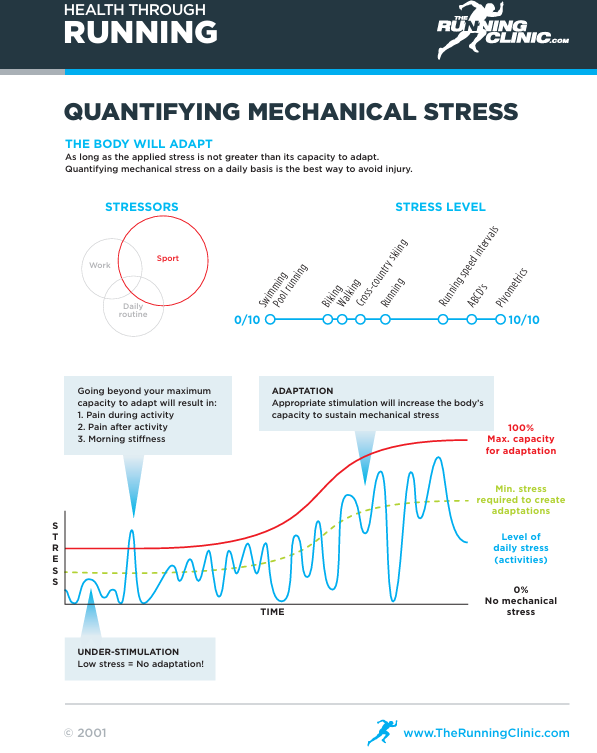
Source: La Clinique du Coureur
Warning Signs: Have You Exceeded Your Maximum Capacity?
When the mechanical stress applied exceeds tissue tolerance, the body provides clear warning signs during the activity or within the following 24 hours:
- Pain during the activity;
- Pain after the activity;
- Morning stiffness or increased tightness following rest;
- Swelling or local warmth around the injured area.
The presence of these signs indicates that the mechanical load was too high and should be adjusted before the next session.
The 4 Variables to Modulate Mechanical Stress
To control the impact of movement on your muscles and joints, four primary training parameters can be adjusted:
- Frequency: The number of sessions per week. Running 5 times a week creates a far greater cumulative load than running twice a week.
- Intensity: The effort level required. Sprints, jumping, or heavy resistance training demand substantially more adaptation than light jogging or low-load exercises.
- Time (Duration): The length of the session. A 2-hour hike challenges tissues significantly more than a 20-minute walk.
- Type of Activity: The nature of the sport or task. Swimming primarily places demands on the shoulders, while running concentrates forces on the knees, ankles, and Achilles tendons.
How to Quantify Mechanical Stress in Everyday Life
To guide your progression with confidence:
- Increase only one variable at a time (duration OR intensity, never both simultaneously).
- Monitor your symptoms during exertion and take note of how your joints or muscles feel 24 hours later.
- Account for sleep, fatigue, and mental stress before choosing the intensity of a workout.
- Avoid sudden spikes in training volume, especially after an extended break.
- Stay within the adaptation zone by respecting early signs of tissue irritation.
The body heals and rebuilds best when physical effort is dosed intelligently. Finding the right balance stimulates tissue adaptation, reduces the risk of recurrence, and facilitates a smooth return to work, sports, and daily routines.
“A healthcare professional will be able to evaluate your specific situation to determine the optimal dosage of mechanical stress suited to your condition and personal goals.”
Looking to return to your favorite activities safely with an individualized exercise plan?
👉 Explore our physiotherapy services
Sources: Clinique Remix Santé, La Clinique du Coureur, Horizon Running.
Back pain: how physiotherapy relieves lo...
Persistent lower back pain? Discover how physiotherapy can effectively relieve your backache with a ...
Lire plus...
Persistent Pain: Why Do Your Symptoms Fl...
Does your pain feel unpredictable? Discover the scientific mechanisms behind daily fluctuations and ...
Lire plus...
Beyond Recovery: Understanding Functiona...
our pain has decreased, but are you truly ready to return to your daily routine? Learn how Functiona...
Lire plus...