
Understanding the origin of shoulder pain and how osteopathy can help you
In Quebec, the three most common reasons for a first osteopathic consultation are neck pain, lower back pain, and shoulder pain. As the most mobile joint in the body, with a range of motion of up to 180 degrees, the shoulder allows us to carry out our daily tasks and activities. It is therefore obvious that pain in this area can be debilitating.
Make an appointment by clicking here.
WHAT IS THE SHOULDER MADE UP OF?
The shoulder is composed of 3 bones: the humerus, the scapula (formerly called the shoulder blade) and the clavicle.
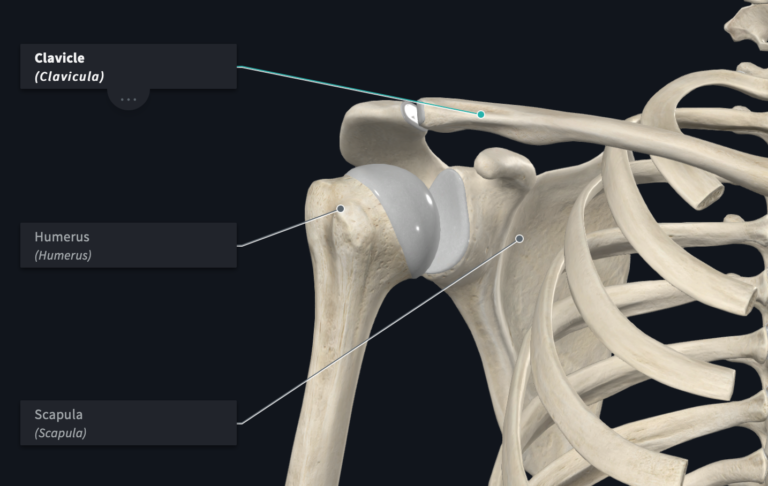
Anatomy of the shoulder bones
The joint is primarily stabilized by a group of 4 muscles (supraspinatus, infraspinatus, teres minor, and subscapularis) known as the rotator cuff. Of course, the shoulder is also stabilized by numerous tendons and ligaments.
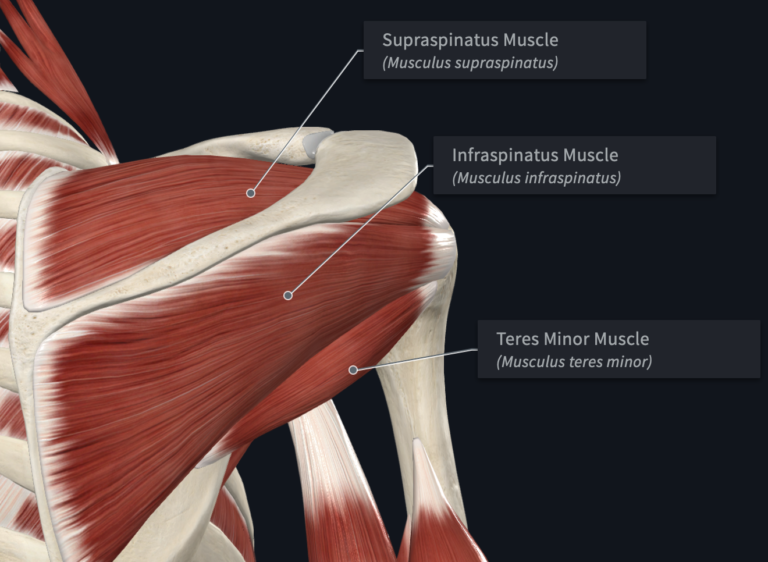
Rear view, rotator cuff muscles
Anterior view, rotator cuff muscles
WHAT ARE THE COMMON CONDITIONS THAT CAUSE SHOULDER PAIN?
- Shoulder Tendinitis: A tendon is a tissue that connects muscle to bone. Tendinitis is an inflammation of one of the shoulder's tendons. There are several possible tendinitis in the area such as: rotator cuff tendinitis, long head of the biceps tendinitis, etc. Tendinitis usually occurs following repetitive movements, trauma, excessive strain, etc. The pain can be constant, but is increased during certain movements. These movements will depend on the affected tendon (The manual’s Editorial Staff, 2022).
- Rotator cuff tear: A partial or complete tear of one of the rotator cuff muscles can occur due to a sudden movement such as pulling, falling, or severe inflammation.
- Shoulder bursitis: A bursa is a fluid-filled sac that facilitates the gliding of skin, muscles, tendons, and ligaments over bones. Bursitis is an inflammation of the synovial bursa. It usually occurs following irritation related to unusual or excessive strain. Bursitis can manifest as pain during the abduction movement of the shoulder (a movement that moves the arm away from the body) (Dalal, 2022).
- Adhesive capsulitis, also known as frozen shoulder: Adhesive capsulitis is an inflammation of the shoulder capsule. It is characterized by pain and a loss of mobility in all shoulder movements, which worsens over time. The pain can also be felt at night. Adhesive capsulitis is a condition that typically presents in three stages. Initially, intense pain that can affect sleep is experienced. This phase can last 3 to 9 months. Subsequently, there is a decrease in pain and shoulder mobility, leading to stiffness. This can last 4 to 12 months. Finally, the stiffness and pain decrease, which can last 12 to 42 months (Cavalleri et al., 2020). Fortunately, with a combination of medical management and manual therapies such as osteopathy, physiotherapy, and acupuncture, the recovery time for adhesive capsulitis can be reduced.
- Dislocation: A dislocation is a displacement of the joint beyond its physiological limit. 95% of dislocations are anterior, meaning that the humerus is pushed forward and out of the joint. Otherwise, a dislocation can occur as a result of a fall. A dislocation must be seen by a doctor in order to quickly reposition the joint. There is also subluxation, which is a partial displacement of the joint (Campagne, 2021).
- Acromioclavicular sprain: Stretching or tearing of the ligaments between the clavicle and the acromion. Usually occurs after a fall or trauma. When a sprain occurs, the shoulder is sensitive. It requires an X-ray to allow the doctor to identify the grade of the sprain.
WHAT TO DO WHEN EXPERIENCING SHOULDER PAIN?
- Apply ice (max 10-15 minutes every two hours as tolerated). Be careful not to put the ice directly on the skin.
- Consult a professional such as an osteopath, a physiotherapist, an acupuncturist, etc.
- If medication needs to be taken, discuss it with the pharmacist
- In case of severe trauma, consult a doctor.
WHAT CAN THE OSTEOPATH DO FOR MY PAIN?
Initially, the osteopath will have a discussion with you to better understand your issues and to learn more about your medical history. Following that, they will perform an assessment of shoulder mobility, as well as a comprehensive evaluation of the body. Then, through their manipulations, they will carry out the treatment while explaining to you what they are doing. Their techniques will help to improve mobility and reduce pain. Finally, they may provide you with advice and exercises, if necessary.
In the case of shoulder pain, the osteopath will pay special attention to the cervical and thoracic regions, to the muscular tensions surrounding the shoulder as well as to the overall posture. These areas can be related to or the cause of shoulder pain due to anatomy.
Schedule an appointment by clicking here.OTHER ARTICLES THAT MIGHT INTEREST YOU
Neck pain, how can osteopathy help me?
Back pain, have you considered consulting in osteopathy?
Headache, how can osteopathy help me?
REFERENCES
Campagne, D. (2021, January). Shoulder Dislocation. https://www.merckmanuals.com/fr-ca/accueil/l%C3%A9sions-et-intoxications/luxations/luxation-de-l-%C3%A9paule?query=capsulite (https://www.merckmanuals.com/fr-ca/accueil/l%C3%A9sions-et-intoxications/luxations/luxation-de-l-%C3%A9paule?query=capsulite)
Cavalleri, E., Servadio, A., Berardi, A., Tofani, M., Galeoto, G. (2020). The effectiveness of physiotherapy in idiopathic or primary frozen shoulder: a systematic review and meta-analysis. 10(1), 24-39. https://doi.org/10.32098/mltj.01.2020.04
Dalal, S.D. (2022, April). Bursitis. https://www.merckmanuals.com/fr-ca/accueil/troubles-osseux,-articulaires-et-musculaires/troubles-des-muscles,-des-bourses-s%C3%A9reuses-et-des-tendons/bursitis?query=bursitis (https://www.merckmanuals.com/fr-ca/accueil/troubles-osseux,-articulaires-et-musculaires/troubles-des-muscles,-des-bourses-s%C3%A9reuses-et-des-tendons/bursitis?query=bursitis)
The manual’s Editorial Staff. (2022, July). Tendinitis. https://www.merckmanuals.com/fr-ca/accueil/les-faits-en-bref-troubles-osseux,-articulaires-et-musculaires/troubles-des-muscles-des-bourses-s%C3%A9reuses-et-des-tendons/tendinite?query=tendinite (https://www.merckmanuals.com/fr-ca/accueil/les-faits-en-bref-troubles-osseux,-articulaires-et-musculaires/troubles-des-muscles-des-bourses-s%C3%A9reuses-et-des-tendons/tendinite?query=tendinite)
Back pain: how physiotherapy relieves lo...
Persistent lower back pain? Discover how physiotherapy can effectively relieve your backache with a ...
Lire plus...
Persistent Pain: Why Do Your Symptoms Fl...
Does your pain feel unpredictable? Discover the scientific mechanisms behind daily fluctuations and ...
Lire plus...
Beyond Recovery: Understanding Functiona...
our pain has decreased, but are you truly ready to return to your daily routine? Learn how Functiona...
Lire plus...